
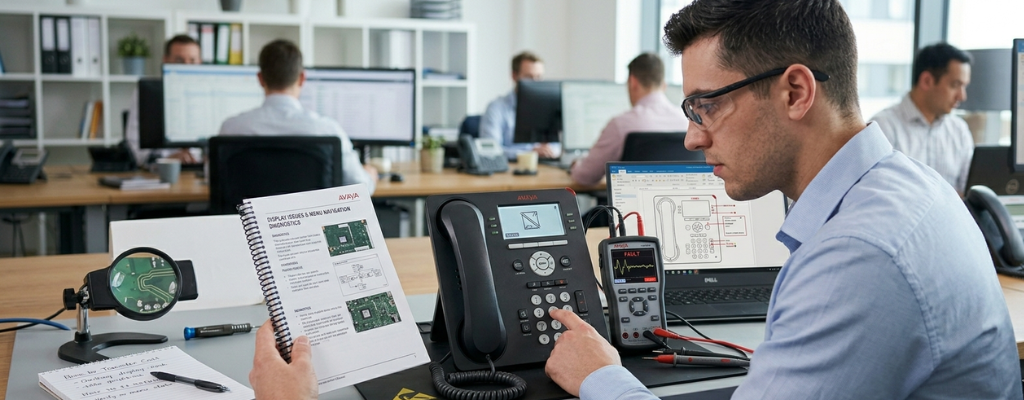
Avaya 1408 Troubleshooting Guide: Fix Static, Display Issues & Menu Problems Fast | Morgan Birgé
Fixing Static, Menu Confusion, and Display Issues on Avaya 1408 Phones
Small Problems That Create Big Frustrations
The Avaya 1408 is a reliable digital desk phone, but even dependable hardware develops quirks over time. Static on calls, a display that's hard to read, getting stuck in menus, and features that don't behave as expected are the complaints that come up most often from 1408 users.
None of these problems is a sign of a phone that needs replacing. Most of them have quick, specific fixes.
Static and Audio Noise
Check the Handset Cord First
The handset cord on any desk phone, the coiled cable connecting the handset to the base, is the most common source of static and crackling. It's subject to constant bending and twisting, and when the internal wires develop a break, the connection becomes intermittent and noisy.
During a power surge or electrostatic discharge event, calls may be dropped, and audio quality may be affected temporarily. If static appears after a power event, unplugging and reconnecting the phone usually clears it. If static is persistent rather than event-related, the handset cord is the first thing to swap.
Replace the handset cord with a known-good spare and test immediately. If the static disappears, the cord was the problem. Replacement cords are inexpensive and take 30 seconds to swap.
Move Away From Interference Sources
Using a cell phone, mobile phone, GSM phone, or two-way radio in close proximity to an Avaya 1408 telephone may cause interference. If static comes and goes rather than being constant, and the affected phone sits near a smartphone charging pad, a wireless router, or a two-way radio, distance is the fix. Moving the phone or the interfering device a few feet apart resolves the majority of proximity-related static issues.
Static Only on External Calls
If static appears only on calls to outside numbers, not on internal calls between extensions, the issue is in the analog trunk line, not the phone. Worn trunk cabling, a degraded port on the phone system, or cabling running parallel to power lines all introduce noise specifically into the external audio path. This requires investigation at the phone system level, not the individual handset.
Display Problems
Display Is Too Dark or Too Bright
The 1408 allows brightness and contrast to be adjusted directly from the phone. Use the Avaya Menu to adjust and customize phone settings, including display brightness and contrast.
To adjust:
Press the A (Menu) button
Select Screen/Sound Options
Select Brightness or Contrast
Use the left and right arrow keys to adjust the level
Press Save
If the display appears completely blank but the phone has power and is functioning (you can hear a dial tone when you lift the handset), the brightness is likely set all the way down. Adjusting it from the menu while using the handset to navigate will bring it back.
Display Shows Wrong Information at Idle
The 1408 gives users control over what appears on the top line of the display when the phone is idle. The top line of the phone can display different information; your system administrator selects the default, but you can then choose which information you want shown. Options include displaying your extension number and the date and time, or your extension number and name.
To change what the idle screen shows:
Press the A (Menu) button
Select Options & Settings
Select Display Controls
Select Display Name or Date & Time, depending on what you want shown
Press Save
Phone Stays in Menu During an Incoming Call
By default, the 1408 exits its menu screens automatically when a new call arrives. The A-Menu Auto Exit setting controls whether the phone automatically exits the menu screens when a new call alerts the phone. If the phone is not exiting menus on incoming calls, this setting may have been turned off.
To re-enable it:
Press the A (Menu) button
Select Options & Settings
Select Display Controls
Select A-Menu Auto Exit and set it to On
Press Save
Menu Confusion: Getting Lost in the Settings
The A (Menu) Button vs. the Phone Button
The most common source of menu confusion on the 1408 is not knowing how to get back to the normal call screen. The diagram for the 1408 identifies the button layout, including the call appearance and feature buttons. The first three buttons are used as appearance buttons for calls made and received by default.
The quick exit from any menu is always the Phone key. Pressing it returns the display to the normal call screen, regardless of where you are in the menu structure. If you're stuck somewhere and can't find your way out, press Phone.
Navigating the A-Menu Structure
The Avaya Menu has six sub-menus: Screen/Sound lets you adjust display brightness, contrast, select your ringing pattern, and turn button click on or off; Call Settings for call-related preferences; Applications for accessing call log and directory; Advanced Options for network settings and language selection; and Log Out.
A quick reference for common settings and where to find them:
Ringtone: A Menu > Screen/Sound Options > Personalized Ringing
Brightness/Contrast: A Menu > Screen/Sound Options > Brightness or Contrast
Language: A Menu > Advanced Options > Language
Do Not Disturb: A Menu > Options & Settings > Call Settings > Do Not Disturb
Log Out: A Menu > Log Out (for hot-desking environments)
Feature Buttons Showing Blank or Unexpected Labels
Any button not configured as an appearance button can be configured for a range of telephone system features. These are called feature buttons. If a feature button displays a blank label or behaves unexpectedly, the button assignment may have been changed in the system configuration, or the feature requires a permission level that the user hasn't been granted.
Button assignments are managed in IP Office Manager by the system administrator. If a button that previously worked stops working or shows no label, report it to your administrator. It's a system configuration change, not a phone fault.
Phone Not Ringing for Incoming Calls
If the phone appears fully operational but doesn't ring for incoming calls, check two things before assuming a fault:
Do Not Disturb is on: The 1408 may not ring if Do Not Disturb is activated or if call filter settings are directing calls elsewhere. To check: press the Avaya Menu button, select Settings, select Display/Acoustics, select Do Not Disturb, and press OK to switch it off.
Ringer volume is at zero: Press the volume up key while the phone is idle, which raises the ringer volume. The ringer and call volume are adjusted separately on the 1408, so it's possible to have call volume set correctly while the ringer is silenced.
Phone Won't Activate After Being Connected
If the phone does not activate after first connecting it, check all lines into the phone to be sure it is properly connected. Also, check the display screen. A blank display after connection usually means the phone isn't receiving power through the line.
For the 1408, power comes through the digital line connection from the phone system. If the display stays completely dark after plugging in:
Verify the cable is connected to a digital line port, not an analog port
Try a different cable to rule out a faulty connection
Confirm the extension port is active in IP Office Manager
Quick Reference: Fix by Symptom
Static on all calls: Swap the handset cord; check for nearby wireless devices
Static only on external calls: Trunk cable or port issue; requires system-level investigation
Display too dark: A Menu > Screen/Sound Options > Brightness > increase and save
Wrong idle display: A Menu > Options & Settings > Display Controls > Display Name or Date & Time
Phone stuck in menus during a call: Enable A-Menu Auto Exit in Display Controls settings
Phone not ringing: Check Do Not Disturb in the A-Menu and verify ringer volume
Dark screen after plugging in: Verify connection to digital line port; test with replacement cable
Need Help With Your 1408 or IP Office System?
If the steps above don't resolve the issue or if problems are appearing across multiple phones rather than just one, the cause is likely in the phone system configuration or hardware layer. A qualified Avaya support provider can identify the root cause and get your phones working reliably again.

We Can Help
Call us at (312) 728-7652 or fill out the form below.
Featured Posts
Avaya 1408 Troubleshooting Guide: Fix Static, Display Issues & Menu Problems Fast | Morgan Birgé
Fixing Static, Menu Confusion, and Display Issues on Avaya 1408 Phones
Small Problems That Create Big Frustrations
The Avaya 1408 is a reliable digital desk phone, but even dependable hardware develops quirks over time. Static on calls, a display that's hard to read, getting stuck in menus, and features that don't behave as expected are the complaints that come up most often from 1408 users.
None of these problems is a sign of a phone that needs replacing. Most of them have quick, specific fixes.
Static and Audio Noise
Check the Handset Cord First
The handset cord on any desk phone, the coiled cable connecting the handset to the base, is the most common source of static and crackling. It's subject to constant bending and twisting, and when the internal wires develop a break, the connection becomes intermittent and noisy.
During a power surge or electrostatic discharge event, calls may be dropped, and audio quality may be affected temporarily. If static appears after a power event, unplugging and reconnecting the phone usually clears it. If static is persistent rather than event-related, the handset cord is the first thing to swap.
Replace the handset cord with a known-good spare and test immediately. If the static disappears, the cord was the problem. Replacement cords are inexpensive and take 30 seconds to swap.
Move Away From Interference Sources
Using a cell phone, mobile phone, GSM phone, or two-way radio in close proximity to an Avaya 1408 telephone may cause interference. If static comes and goes rather than being constant, and the affected phone sits near a smartphone charging pad, a wireless router, or a two-way radio, distance is the fix. Moving the phone or the interfering device a few feet apart resolves the majority of proximity-related static issues.
Static Only on External Calls
If static appears only on calls to outside numbers, not on internal calls between extensions, the issue is in the analog trunk line, not the phone. Worn trunk cabling, a degraded port on the phone system, or cabling running parallel to power lines all introduce noise specifically into the external audio path. This requires investigation at the phone system level, not the individual handset.
Display Problems
Display Is Too Dark or Too Bright
The 1408 allows brightness and contrast to be adjusted directly from the phone. Use the Avaya Menu to adjust and customize phone settings, including display brightness and contrast.
To adjust:
Press the A (Menu) button
Select Screen/Sound Options
Select Brightness or Contrast
Use the left and right arrow keys to adjust the level
Press Save
If the display appears completely blank but the phone has power and is functioning (you can hear a dial tone when you lift the handset), the brightness is likely set all the way down. Adjusting it from the menu while using the handset to navigate will bring it back.
Display Shows Wrong Information at Idle
The 1408 gives users control over what appears on the top line of the display when the phone is idle. The top line of the phone can display different information; your system administrator selects the default, but you can then choose which information you want shown. Options include displaying your extension number and the date and time, or your extension number and name.
To change what the idle screen shows:
Press the A (Menu) button
Select Options & Settings
Select Display Controls
Select Display Name or Date & Time, depending on what you want shown
Press Save
Phone Stays in Menu During an Incoming Call
By default, the 1408 exits its menu screens automatically when a new call arrives. The A-Menu Auto Exit setting controls whether the phone automatically exits the menu screens when a new call alerts the phone. If the phone is not exiting menus on incoming calls, this setting may have been turned off.
To re-enable it:
Press the A (Menu) button
Select Options & Settings
Select Display Controls
Select A-Menu Auto Exit and set it to On
Press Save
Menu Confusion: Getting Lost in the Settings
The A (Menu) Button vs. the Phone Button
The most common source of menu confusion on the 1408 is not knowing how to get back to the normal call screen. The diagram for the 1408 identifies the button layout, including the call appearance and feature buttons. The first three buttons are used as appearance buttons for calls made and received by default.
The quick exit from any menu is always the Phone key. Pressing it returns the display to the normal call screen, regardless of where you are in the menu structure. If you're stuck somewhere and can't find your way out, press Phone.
Navigating the A-Menu Structure
The Avaya Menu has six sub-menus: Screen/Sound lets you adjust display brightness, contrast, select your ringing pattern, and turn button click on or off; Call Settings for call-related preferences; Applications for accessing call log and directory; Advanced Options for network settings and language selection; and Log Out.
A quick reference for common settings and where to find them:
Ringtone: A Menu > Screen/Sound Options > Personalized Ringing
Brightness/Contrast: A Menu > Screen/Sound Options > Brightness or Contrast
Language: A Menu > Advanced Options > Language
Do Not Disturb: A Menu > Options & Settings > Call Settings > Do Not Disturb
Log Out: A Menu > Log Out (for hot-desking environments)
Feature Buttons Showing Blank or Unexpected Labels
Any button not configured as an appearance button can be configured for a range of telephone system features. These are called feature buttons. If a feature button displays a blank label or behaves unexpectedly, the button assignment may have been changed in the system configuration, or the feature requires a permission level that the user hasn't been granted.
Button assignments are managed in IP Office Manager by the system administrator. If a button that previously worked stops working or shows no label, report it to your administrator. It's a system configuration change, not a phone fault.
Phone Not Ringing for Incoming Calls
If the phone appears fully operational but doesn't ring for incoming calls, check two things before assuming a fault:
Do Not Disturb is on: The 1408 may not ring if Do Not Disturb is activated or if call filter settings are directing calls elsewhere. To check: press the Avaya Menu button, select Settings, select Display/Acoustics, select Do Not Disturb, and press OK to switch it off.
Ringer volume is at zero: Press the volume up key while the phone is idle, which raises the ringer volume. The ringer and call volume are adjusted separately on the 1408, so it's possible to have call volume set correctly while the ringer is silenced.
Phone Won't Activate After Being Connected
If the phone does not activate after first connecting it, check all lines into the phone to be sure it is properly connected. Also, check the display screen. A blank display after connection usually means the phone isn't receiving power through the line.
For the 1408, power comes through the digital line connection from the phone system. If the display stays completely dark after plugging in:
Verify the cable is connected to a digital line port, not an analog port
Try a different cable to rule out a faulty connection
Confirm the extension port is active in IP Office Manager
Quick Reference: Fix by Symptom
Static on all calls: Swap the handset cord; check for nearby wireless devices
Static only on external calls: Trunk cable or port issue; requires system-level investigation
Display too dark: A Menu > Screen/Sound Options > Brightness > increase and save
Wrong idle display: A Menu > Options & Settings > Display Controls > Display Name or Date & Time
Phone stuck in menus during a call: Enable A-Menu Auto Exit in Display Controls settings
Phone not ringing: Check Do Not Disturb in the A-Menu and verify ringer volume
Dark screen after plugging in: Verify connection to digital line port; test with replacement cable
Need Help With Your 1408 or IP Office System?
If the steps above don't resolve the issue or if problems are appearing across multiple phones rather than just one, the cause is likely in the phone system configuration or hardware layer. A qualified Avaya support provider can identify the root cause and get your phones working reliably again.
Enroll in Our Email Course

Learn How a No-Nonsense IT Strategy Benefits Your Company:
Strategies to allocate your IT budget efficiently
Enhance cybersecurity defenses on a budget
Ensure your technology investments continue to serve your business as it grows
Let’s Take Your Business to the Next Level
Above all, we promise never to hit you with hidden fees. We won’t push the "newest, fanciest, coolest" tech trends just for the sake of it. We're here to deliver reliable, integrity-driven communication solutions that work better and more efficiently than what you may be managing in-house.
To find out if managed services is the right fit for your business, contact us for a free assessment.
77 W Washington ST STE, 1705 Chicago, IL 60602
Indiana Office
114 E Joliet St
Schererville, IN 46375
© 2026 Morgan Birgé. All Rights Reserved. Built With MSP Sites | Privacy Policy
