
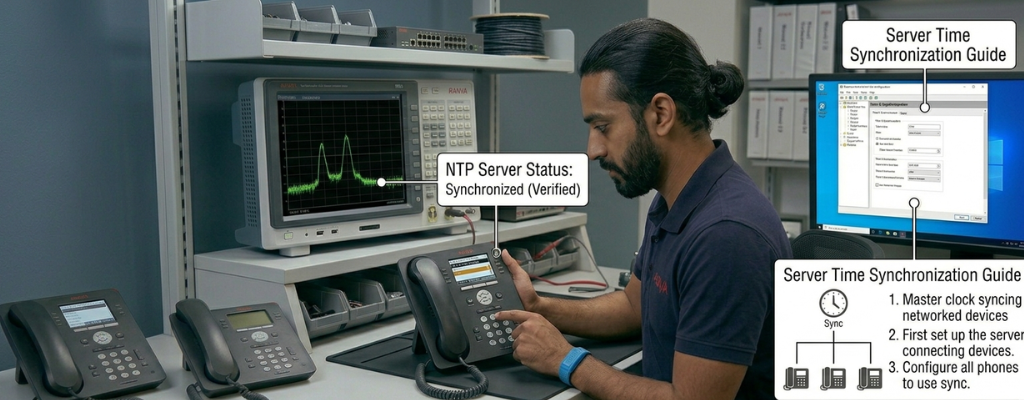
Avaya Phone Time Wrong? How to Set and Fix Time on IP Office & Partner Systems | Morgan Birgé
How to Set the Correct Time on Your Avaya Phone (IP and Digital Models)
Why the Time on Your Avaya Phones Keeps Being Wrong
An Avaya phone that displays the wrong time isn't just a minor annoyance. It throws off voicemail timestamps, disrupts call routing based on time-of-day schedules, and can cause auto-attendant greetings to play at the wrong times. If your phones are showing the wrong time or reset after every reboot, the fix starts inside the system configuration, not on the phone itself.
Avaya phones get their time from the phone system, not from an internal clock. That means adjusting the time on individual phones does nothing permanent; the system pushes the time back to whatever it's configured to use.
How Avaya IP Office Gets Its Time
IP Office has three time source options, controlled by a setting called Time Setting Configuration Source inside IP Office Manager. The three options are SNTP (a time server on the internet or your local network), Voicemail Pro/Manager (where the Voicemail Pro server or IP Office Manager acts as the time source), and None (where the time is set manually from a designated phone).
Choosing the right source for your environment is the most important decision in this process. Here's what each one means in practice.
Option 1: SNTP: The Recommended Method
SNTP stands for Simple Network Time Protocol. It's the same method computers use to stay accurately synchronized. The system checks in with a time server on the internet and keeps itself updated automatically.
The best approach is to point the Time Setting Config Source to an SNTP server. If your office runs on a Windows network, pointing IP Office at your Primary Domain Controller keeps the phone system's time in sync with all other devices on the network automatically. Alternatively, a public SNTP server address works just as well.
To configure SNTP in IP Office Manager:
Open the IP Office Manager and receive the configuration
Navigate to System > System tab
Set Time Setting Config Source to SNTP
Enter the SNTP server address, use your Windows server's IP address, or a public server such as 0.pool.ntp.org
Save and merge the configuration
If using a public SNTP server, entering multiple server addresses is recommended, as the system uses responses from each to determine reliability, and having backups prevents time drift if one server becomes unreachable.
One important note: your firewall must allow outbound UDP traffic on port 123 for the system to reach an external SNTP server. If SNTP isn't working, this is the first thing to check with your IT team.
Option 2: Voicemail Pro / Manager
IP Office can obtain its time from the Voicemail Pro server or from a PC running IP Office Manager. Both act as time servers using the RFC868 protocol. Note that this is different from standard NTP, and other RFC868 sources are not supported.
This option works well in environments where Voicemail Pro is running on a dedicated Windows server that maintains accurate time. To configure it:
In IP Office Manager, navigate to System > System tab
Set Time Setting Config Source to VoiceMail Pro/Manager
Save and merge
An important caveat: if IP Office Manager is open and running when Voicemail Pro starts, Voicemail Pro does not start its time server process. Always close IP Office Manager before starting or restarting Voicemail Pro; otherwise, the time sync won't function.
Option 3: Setting the Time Manually From a Phone
If your system has no access to a time server, the time can be set manually from a designated Avaya phone. This requires giving one user "System Phone Rights" in IP Office Manager first.
Step 1: Grant System Phone Rights in IP Office Manager:
Open the IP Office Manager and receive the configuration
Navigate to System > System tab
Set Time Setting Config Source to None
Navigate to the User section and select the user for the phone you'll use
On the User tab, change System Phone Rights from None to Level 2
Save and merge the configuration
Step 2: Set the time from the phone:
Press the Feature key, then press the down arrow until Phone User appears on the display and press Select. Press down to System Admin and press Select. Press down to Time and press Select or OK. Enter the correct time in 24-hour format using the keypad, using the * key for the colon, then press the Done soft key.
The date can be set the same way, navigate to Date instead of Time in the System Admin menu.
Setting the Time on an Avaya Partner ACS (Digital System)
The Partner ACS handles time differently from IP Office. The time is set directly from extension 10 or 11, no software or computer required.
Press Feature 0 0 (the zero key twice)
Press System Program, then System Program again
Dial #103 for time or #101 for date
Enter the time in 12-hour format (for example, 0130PM for 1:30 PM)
Press Enter to confirm
The system applies the change immediately across all phones on the system.
Why the Time Keeps Drifting or Resetting
If the time is correct after a manual adjustment but drifts again after a reboot or within a few days, the cause is almost always one of these:
Time source set to None with no phone override — the system has no automatic source and relies entirely on manual updates
SNTP server unreachable — the firewall is blocking port 123, or the server address is incorrect
Voicemail Pro not running — if the source is set to Voicemail Pro and the service is down, the system loses its time reference
A time difference between the IP Office server and the local time standard, such as a 6-minute offset, points to the IP Office not being configured to use the customer's NTP server, causing gradual drift over time.
The permanent fix is always to configure a reliable automatic time source, SNTP being the most stable and recommended option.
Quick Reference: Time Setting by System Type
IP Office — automatic, recommended: Set Time Setting Config Source to SNTP and enter a server address
IP Office — server-based: Set to Voicemail Pro/Manager; ensure Manager is closed when VMP starts
IP Office — manual: Set to None; grant System Phone Rights to a user; set time from their phone
Partner ACS: Press Feature 0 0, dial #103, enter time in 12-hour format from extension 10 or 11
Still Showing the Wrong Time?
If the time keeps drifting, won't update after configuration changes, or is affecting your call routing and voicemail schedules, a qualified Avaya support provider can identify whether the issue is in the system configuration, the network, or the time source setup, and get it corrected permanently.

We Can Help
Call us at (312) 728-7652 or fill out the form below.
Featured Posts
Avaya Phone Time Wrong? How to Set and Fix Time on IP Office & Partner Systems | Morgan Birgé
How to Set the Correct Time on Your Avaya Phone (IP and Digital Models)
Why the Time on Your Avaya Phones Keeps Being Wrong
An Avaya phone that displays the wrong time isn't just a minor annoyance. It throws off voicemail timestamps, disrupts call routing based on time-of-day schedules, and can cause auto-attendant greetings to play at the wrong times. If your phones are showing the wrong time or reset after every reboot, the fix starts inside the system configuration, not on the phone itself.
Avaya phones get their time from the phone system, not from an internal clock. That means adjusting the time on individual phones does nothing permanent; the system pushes the time back to whatever it's configured to use.
How Avaya IP Office Gets Its Time
IP Office has three time source options, controlled by a setting called Time Setting Configuration Source inside IP Office Manager. The three options are SNTP (a time server on the internet or your local network), Voicemail Pro/Manager (where the Voicemail Pro server or IP Office Manager acts as the time source), and None (where the time is set manually from a designated phone).
Choosing the right source for your environment is the most important decision in this process. Here's what each one means in practice.
Option 1: SNTP: The Recommended Method
SNTP stands for Simple Network Time Protocol. It's the same method computers use to stay accurately synchronized. The system checks in with a time server on the internet and keeps itself updated automatically.
The best approach is to point the Time Setting Config Source to an SNTP server. If your office runs on a Windows network, pointing IP Office at your Primary Domain Controller keeps the phone system's time in sync with all other devices on the network automatically. Alternatively, a public SNTP server address works just as well.
To configure SNTP in IP Office Manager:
Open the IP Office Manager and receive the configuration
Navigate to System > System tab
Set Time Setting Config Source to SNTP
Enter the SNTP server address, use your Windows server's IP address, or a public server such as 0.pool.ntp.org
Save and merge the configuration
If using a public SNTP server, entering multiple server addresses is recommended, as the system uses responses from each to determine reliability, and having backups prevents time drift if one server becomes unreachable.
One important note: your firewall must allow outbound UDP traffic on port 123 for the system to reach an external SNTP server. If SNTP isn't working, this is the first thing to check with your IT team.
Option 2: Voicemail Pro / Manager
IP Office can obtain its time from the Voicemail Pro server or from a PC running IP Office Manager. Both act as time servers using the RFC868 protocol. Note that this is different from standard NTP, and other RFC868 sources are not supported.
This option works well in environments where Voicemail Pro is running on a dedicated Windows server that maintains accurate time. To configure it:
In IP Office Manager, navigate to System > System tab
Set Time Setting Config Source to VoiceMail Pro/Manager
Save and merge
An important caveat: if IP Office Manager is open and running when Voicemail Pro starts, Voicemail Pro does not start its time server process. Always close IP Office Manager before starting or restarting Voicemail Pro; otherwise, the time sync won't function.
Option 3: Setting the Time Manually From a Phone
If your system has no access to a time server, the time can be set manually from a designated Avaya phone. This requires giving one user "System Phone Rights" in IP Office Manager first.
Step 1: Grant System Phone Rights in IP Office Manager:
Open the IP Office Manager and receive the configuration
Navigate to System > System tab
Set Time Setting Config Source to None
Navigate to the User section and select the user for the phone you'll use
On the User tab, change System Phone Rights from None to Level 2
Save and merge the configuration
Step 2: Set the time from the phone:
Press the Feature key, then press the down arrow until Phone User appears on the display and press Select. Press down to System Admin and press Select. Press down to Time and press Select or OK. Enter the correct time in 24-hour format using the keypad, using the * key for the colon, then press the Done soft key.
The date can be set the same way, navigate to Date instead of Time in the System Admin menu.
Setting the Time on an Avaya Partner ACS (Digital System)
The Partner ACS handles time differently from IP Office. The time is set directly from extension 10 or 11, no software or computer required.
Press Feature 0 0 (the zero key twice)
Press System Program, then System Program again
Dial #103 for time or #101 for date
Enter the time in 12-hour format (for example, 0130PM for 1:30 PM)
Press Enter to confirm
The system applies the change immediately across all phones on the system.
Why the Time Keeps Drifting or Resetting
If the time is correct after a manual adjustment but drifts again after a reboot or within a few days, the cause is almost always one of these:
Time source set to None with no phone override — the system has no automatic source and relies entirely on manual updates
SNTP server unreachable — the firewall is blocking port 123, or the server address is incorrect
Voicemail Pro not running — if the source is set to Voicemail Pro and the service is down, the system loses its time reference
A time difference between the IP Office server and the local time standard, such as a 6-minute offset, points to the IP Office not being configured to use the customer's NTP server, causing gradual drift over time.
The permanent fix is always to configure a reliable automatic time source, SNTP being the most stable and recommended option.
Quick Reference: Time Setting by System Type
IP Office — automatic, recommended: Set Time Setting Config Source to SNTP and enter a server address
IP Office — server-based: Set to Voicemail Pro/Manager; ensure Manager is closed when VMP starts
IP Office — manual: Set to None; grant System Phone Rights to a user; set time from their phone
Partner ACS: Press Feature 0 0, dial #103, enter time in 12-hour format from extension 10 or 11
Still Showing the Wrong Time?
If the time keeps drifting, won't update after configuration changes, or is affecting your call routing and voicemail schedules, a qualified Avaya support provider can identify whether the issue is in the system configuration, the network, or the time source setup, and get it corrected permanently.
Enroll in Our Email Course

Learn How a No-Nonsense IT Strategy Benefits Your Company:
Strategies to allocate your IT budget efficiently
Enhance cybersecurity defenses on a budget
Ensure your technology investments continue to serve your business as it grows
Let’s Take Your Business to the Next Level
Above all, we promise never to hit you with hidden fees. We won’t push the "newest, fanciest, coolest" tech trends just for the sake of it. We're here to deliver reliable, integrity-driven communication solutions that work better and more efficiently than what you may be managing in-house.
To find out if managed services is the right fit for your business, contact us for a free assessment.
77 W Washington ST STE, 1705 Chicago, IL 60602
Indiana Office
114 E Joliet St
Schererville, IN 46375
© 2026 Morgan Birgé. All Rights Reserved. Built With MSP Sites | Privacy Policy
