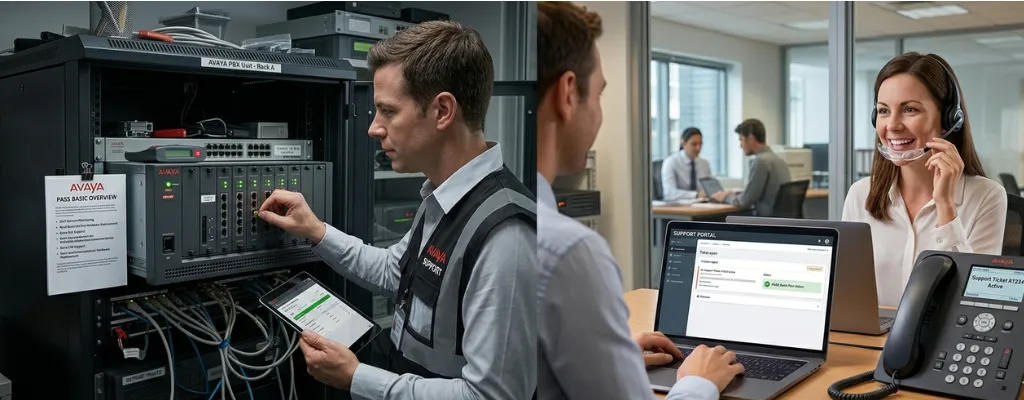
Avaya PASS Basic Explained | When Basic Phone Support Isn’t Enough | Morgan Birgé
Avaya PASS Basic Explained: When Your Phone System Needs More Than Basic Support
What Is Avaya PASS Basic?
If you own or manage an Avaya IP Office phone system, you've likely encountered the term "PASS Basic" or been told you need it. PASS stands for Partner and Avaya Support Services, and the Basic tier is Avaya's entry-level support plan for IP Office systems.
It exists to give businesses a direct line to Avaya's technical team when something goes wrong. But like most entry-level plans, it comes with real limitations that aren't always clearly explained upfront.
What PASS Basic Actually Covers
At its core, PASS Basic gives you access to Avaya's remote support team. Here's what that includes:
Remote technical support: You can contact Avaya's Service Center by phone or online to report software and hardware issues.
24/7 access: Support is available around the clock, not just during business hours.
Software updates and security patches: Your system stays eligible to receive minor updates that address bugs and vulnerabilities.
Hardware fault support: If a covered component fails, Avaya can assist with diagnosis remotely.
PASS Basic is the minimum coverage level required to receive any Avaya support at all; without it, your system is ineligible for reactive assistance from Avaya's Service Center. For many businesses, it's the baseline that keeps the relationship with Avaya intact.
What PASS Basic Does Not Cover
This is where most businesses get caught off guard. PASS Basic sounds comprehensive, until something goes wrong and you discover it doesn't apply.
Here's what's explicitly excluded:
Major software upgrades: PASS Basic does not include entitlement to major software upgrades. If you want to move to a new release version, that's a separate cost.
On-site support: All assistance is remote. If your issue requires a technician physically at your location, that's billed separately at time-and-material rates.
Phone and desk terminal replacement: Replacement of terminals is not included in any IP Office Basic Support Service coverage option. If a desk phone fails, you're buying a new one.
Customized configurations: Support does not cover customized system features or reports. If a problem stems from configuration changes made by your team, a partner, or a third party, resolution fees may be charged at Avaya's per-incident rates.
Non-standard environments: Support is limited to unaltered versions of the product operating in a standard environment. Problems that can't be reproduced in a standard setup may fall outside the scope of covered support.
The pattern here is clear: PASS Basic covers reactive, remote support for standard configurations. Anything beyond that requires either a higher-tier plan or out-of-pocket charges.
The Gap Between Basic Support and What Businesses Actually Need
Most businesses don't run textbook-standard phone system configurations. Over time, systems get customized: call flows are modified, integrations are added, and settings get adjusted to fit how the business actually operates.
The moment a problem traces back to one of those customizations, PASS Basic steps aside. You're no longer covered, and you're looking at per-incident billing that adds up quickly.
There's also the upgrade gap to consider. While PASS-level IPOSS coverage entitles you to receive new software releases, it does not include the hardware or the technical labor required to actually perform the upgrade. The software is "free" in the sense that it's included, but getting it onto your system correctly still requires paid work.
For businesses that rely heavily on their phones, this is the gap that matters most. Basic support handles break-fix scenarios when they fit a narrow definition. It doesn't cover the proactive maintenance, configuration management, or upgrade planning that keeps a system healthy over time.
When PASS Basic Is Enough
PASS Basic is a reasonable fit for businesses that:
Have a simple, standard IP Office configuration that hasn't been heavily customized
Have an internal IT resource or an active reseller relationship who handles day-to-day management
Only need Avaya support as a backstop for major hardware failures
Are not planning software upgrades in the near term
In those situations, the Basic plan provides the access you need without paying for services you won't use.
When You've Outgrown It
PASS Basic starts to show its limits when:
Your system has custom call flows, integrations, or configurations built up over time
You need someone to manage upgrades end-to-end, not just hand you a software file
You're experiencing recurring issues that require more than a remote call to fix
Your business can't afford extended downtime and needs a faster, more hands-on response
A managed or higher-tier support plan typically ensures that a team of phone system experts is available to perform proactive maintenance, apply upgrades, and escalate to Avaya's technical assistance team when deeper vendor-level support is needed. That's a meaningfully different level of coverage than what Basic provides.
The Reseller Factor
One thing PASS Basic doesn't change is your need for a qualified reseller or support partner. Avaya's direct support team handles software-level issues; they don't manage your day-to-day configuration, handle moves and changes, or plan upgrades on your behalf.
All customers using IPOSS-level coverage typically require an active reseller or managed services contract alongside it; without that relationship, accessing and acting on Avaya's support is difficult in practice. The two work together. Avaya handles escalated software issues; your reseller handles everything else.
If you don't have an active reseller relationship, PASS Basic provides less practical value than it appears to on paper.
What to Ask Before You Sign
Before renewing or purchasing PASS Basic, it's worth asking a few direct questions:
Does my current configuration qualify as "standard" under Avaya's support terms?
Am I planning any upgrades in the next 12 months, and are those covered?
Do I have a reseller or partner who can act on Avaya's support alongside this plan?
If something breaks on-site, what does the response actually look like under this plan?
The answers will tell you quickly whether Basic is the right tier for your situation, or whether you're paying for coverage that won't actually be there when you need it.
When PASS Basic Isn’t Enough
PASS Basic gives you a foundation, but it's not a complete support strategy for most businesses. Understanding exactly what it covers and where it stops is the difference between having real protection and having a plan that sounds good until something goes wrong. Telecommunications Provider works with businesses to make sure their Avaya support coverage matches how they actually use their system, so you get reliable uptime, faster issue resolution, and peace of mind when problems inevitably arise.