How Much Does a Business Phone System Cost in 2026?
If you've been putting off upgrading your phone system because you're not sure what to budget, you're not alone. Pricing in this space has changed a lot over the past few years, and the number of options out there doesn't make the decision any easier.
Here's the honest breakdown: what you'll pay depends on the type of system, the number of users, the features you need, and whether you want to own hardware or pay monthly. This guide walks through all of it.
The Short Answer
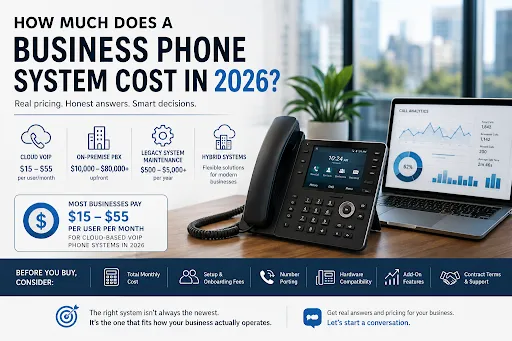
Most businesses pay between $15 and $55 per user per month for a cloud-based VoIP phone system in 2026. A small team of 10 users can typically expect a monthly service bill somewhere between $150 and $500, before hardware.
On-premise systems cost more upfront, often $10,000 to $80,000 or more depending on scale, but have lower ongoing fees. Legacy systems that still run well (Avaya, Nortel) can often be maintained at a fraction of replacement cost.
The right answer isn't always the newest option. It's the one that fits how your business actually operates.
Types of Business Phone Systems and What They Cost
1. Cloud VoIP (Hosted Phone Systems)
Cloud VoIP routes calls over your internet connection instead of traditional phone lines. The provider hosts everything off-site, so there's no server to buy or maintain.
Call recording, analytics, CRM integration, contact center features
Popular providers like RingCentral, Nextiva, Vonage, and Dialpad all fall within this range. Pricing drops with annual contracts and increases with more users.
Hardware add-on: If you want physical desk phones, budget an additional $100 to $400 per phone for IP-compatible handsets.
Best for: Businesses with remote or hybrid teams, those who want low upfront costs, and companies planning to grow.
2. On-Premise PBX
An on-premise PBX (Private Branch Exchange) system lives in your building. You own the hardware, manage it internally or through a vendor, and pay for maintenance rather than a monthly service subscription.
Typical costs:
Hardware (servers, phones, cabling): $10,000 to $80,000 depending on user count
Per-phone cost: $100 to $500 for IP desk phones
Annual maintenance contract: 10% to 15% of hardware value, per year
Installation and configuration: $1,000 to $10,000+
A 5-year total cost of ownership (TCO) for a 25-person on-premise setup often runs $40,000 to $70,000. For comparison, a cloud system for the same team over five years might run $25,000 to $50,000 depending on tier.
Best for: Businesses with complex call routing needs, industries with strict data compliance requirements, or organizations that prefer to own their infrastructure.
3. Legacy System Maintenance (Avaya, Nortel, etc.)
This is a category most pricing guides skip over, but it matters. Thousands of businesses are still running Avaya IP Office, Avaya Definity, or Nortel BCM and MICS systems. These platforms are stable, familiar to staff, and still functional.
Replacing a working system isn't always the right move. Maintenance, parts sourcing, and firmware support from a qualified vendor can often keep these systems running for years at a cost far below a full replacement.
Typical maintenance costs:
Annual support contract: $500 to $5,000+ depending on system size
Individual part replacements: $50 to $800 per component
On-site labor for repairs or adds/moves/changes: $100 to $200 per hour
If your current system is working and your team knows how to use it, the real question is whether the cost of maintaining it is lower than the cost of switching. Often, it is.
4. Hybrid Systems
Some businesses run a mix: cloud-based lines for remote staff or overflow, with an on-premise PBX handling the core office. Hybrid setups give you flexibility but add complexity.
Typical costs: Varies widely. Expect to pay both a hardware maintenance cost and a per-user cloud fee, offset by the fact that you're using cloud lines only where you need them.
Hidden Costs to Watch For
The monthly per-user fee isn't the whole picture. Before signing anything, ask about:
Setup and onboarding fees. Some cloud providers charge $50 to $500 per user to port numbers, configure the system, and train staff.
Number porting. Moving your existing phone numbers to a new carrier takes time and sometimes costs money. Not all providers handle this smoothly.
Hardware compatibility. Your existing phones may not work with a new VoIP platform. Replacement costs add up fast for larger teams.
International calling. Most base plans cover domestic calls only. International rates vary widely by provider and can spike your bill if you have clients or vendors overseas.
Add-on features. Call recording, advanced analytics, and call center functionality are often sold as add-ons rather than included in standard plans.
Contract length penalties. Month-to-month plans are more expensive. Annual contracts save money but lock you in. Read the termination clause before you commit.
Cost by Business Size
1 to 5 Users (Startup or Solo Operator)
A basic cloud plan will run $15 to $30 per user per month, or $75 to $150 total. Tools like Grasshopper or Google Voice for Business are worth considering at this scale. Physical phones are optional.
6 to 25 Users (Small Business)
Expect $150 to $1,000 per month for cloud service depending on tier. Budget an additional $1,500 to $5,000 one-time for compatible desk phones if your team works in an office. On-premise starts to make sense in this range if you have an in-house IT person.
26 to 100 Users (Mid-Size Business)
Cloud plans in this range run $750 to $5,000+ per month. On-premise TCO over five years can be competitive, especially if you already have infrastructure in place. This is also the range where a hybrid approach or a managed services relationship becomes worth exploring.
100+ Users (Enterprise or Multi-Site)
Pricing shifts to custom quotes. Enterprise cloud agreements often include volume discounts, dedicated support, SLA guarantees, and deeper integrations. On-premise and hosted hybrid deployments are common at this scale.
What Drives Prices Up (and Down)
Prices go up when you add:
Call recording and storage
CRM or helpdesk integrations (Salesforce, HubSpot, ServiceNow, etc.)
Contact center or call queue functionality
Video conferencing built into the platform
Toll-free number hosting
International lines
Prices come down when you:
Commit to an annual contract
Reduce the number of feature tiers needed
Negotiate during end-of-quarter sales cycles
Leverage a managed services partner who has existing provider relationships
VoIP vs. Traditional Landlines: The Cost Gap Is Real
Traditional POTS (Plain Old Telephone Service) lines typically run $40 to $80 per line per month. For a 20-line business, that's $800 to $1,600 monthly, just for basic dial tone. No mobile app, no auto-attendant, no voicemail-to-email.
VoIP at the same scale runs $300 to $1,000 per month and includes features that POTS lines can't offer at any price.
If you're still on traditional landlines, the cost savings from switching to VoIP alone tend to justify the move, before you factor in functionality.
Questions to Ask Before You Buy
Getting an honest quote from any vendor starts with knowing what to ask:
What is the total monthly cost for my specific user count and feature needs?
What's included in onboarding, and what costs extra?
Can I keep my existing phone numbers, and what does porting cost?
Are my current desk phones compatible with your system?
What happens if I need to cancel before my contract ends?
What support is included, and what are the response time guarantees?
Is there a way to phase the rollout to avoid downtime?
Any vendor who can't answer those questions clearly and upfront is worth being cautious about.
Should You Replace or Maintain Your Current System?
This question comes up more than any other for businesses running older Avaya or Nortel systems. The answer depends on a few factors:
Keep and maintain if:
The system is stable and your staff knows it well
You're not adding significant headcount in the next two to three years
Replacement cost exceeds what maintenance costs over that same period
Your call volume and routing needs are met by the current system
Plan a replacement if:
You're adding remote workers and the system can't support them well
Hardware failures are becoming more frequent and parts are getting harder to source
You're losing productivity because the system can't integrate with newer tools
The total cost of annual maintenance is approaching what a modern system would cost monthly
A qualified partner can help you run that comparison with real numbers rather than guesswork.
The Bottom Line
There's no single "right" price for a business phone system in 2026. The range is genuinely wide, from $15 per user per month on a basic cloud plan to $80,000+ for a full enterprise on-premise build-out.
What matters is matching the system to how your business actually works, not the other way around. A well-maintained legacy system serving a 20-person team is a better investment than a shiny new cloud platform that nobody uses correctly.
If you want to know what a replacement, upgrade, or maintenance contract would actually cost for your setup, the best next step is a conversation with someone who's seen enough systems to give you a straight answer.